
CI/CD systems are driven by configuration, conventions, and documentation. Without access to that knowledge, AI agents are forced to guess. This leads to brittle pipelines, incorrect YAML, and fixes that don’t quite work.
For AI to be truly useful in DevOps, it needs the same source of truth humans rely on: the docs.
MCP Documentation Resource
Semaphore MCP doc_tools resource gives AI agents structured, read-only access to Semaphore’s official documentation. This includes details about pipeline configuration, YAML syntax, available features, and best practices. Instead of guessing how Semaphore works, an AI can now look it up just like a human would.
When an agent needs to create or modify a pipeline, it can:
- Read the Semaphore pipeline YAML documentation
- Understand required and optional fields
- Learn how caching, test reports, and workflows are configured
- Apply correct syntax and semantics on the first attempt
Automatically Creating a Working Pipeline
Once the AI agent has access to both the repository and Semaphore’s documentation through doc_tools, it can move from understanding to execution.
I asked Claude to generate a brand new semaphore.yml file for my project. What I get is a pipeline built with awareness of the repository’s language, dependencies, and test structure, combined with Semaphore’s recommended configuration patterns.
The resulting pipeline does exactly what we asked:
- Runs the project linter
- Executes unit tests
- Caches dependencies to speed up future runs

Improving Feedback with Test Reports
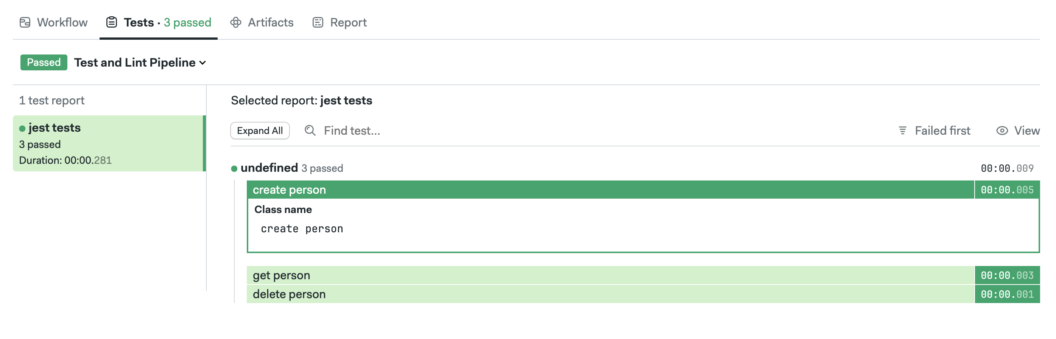
At this point, the pipeline is working as intended: linters run, unit tests execute, and results are visible in the build logs. Test reports transform unstructured console output into structured, machine-readable data. They make it easy to see which tests failed, why they failed, and how failures evolve over time.
So, I asked Claude to configure test reports for my project. The result is that:
- All test failures are collected in one place
- Results are easier to review and compare
- AI agents can quickly access structured failure data instead of parsing logs
Next Steps
When AI agents are grounded in authoritative docs and given structured access to CI/CD systems, they stop guessing and start collaborating. Semaphore’s MCP Server makes that possible by turning pipelines, logs, and documentation into shared knowledge that both humans and AI can work with.
Semaphore’s MCP Server is being actively developed with this future in mind. The goal is simple but ambitious: give AI agents the same depth of understanding and operational access that experienced engineers have. In the next update, we plan to augment security using OAuth authentication.
Thank you for reading and happy building 🚀
Want to discuss this article? Join our Discord.