Agent-native CI · open source
The CI built for coding agents: fast, affordable, and enterprise-ready.
Tell your agent what you want. It runs your CI.





STAGE BY STAGE
See it work
No setup. Just ask.
You don’t configure anything or learn a new tool. Tell your agent what you want, and it sets up your CI for you — and connects you to Semaphore along the way.
Check it before you push.
Made a change? Your agent runs it first in a quick, production-identical sandbox — so you catch problems before they ever reach CI. Warm the box once, then run check after check in seconds.
Reliable Execution
Stable, reproducible test runs that pass more often on the first try, reducing re-runs and shortening PR-to-merge time.
CI that keeps up with your code.
As your codebase grows, your agent keeps CI fast and healthy — spotting slow steps and flaky tests and fixing them as it goes. Maintenance and optimization are built in.
Fast & affordable
Fast CI, and you only pay for what you run.
Every organization starts with $15 of free usage every month. After that, you pay for the CI you actually run — no per-seat fees, no idle costs. Fast machines keep pipelines short, so there’s less to pay for. See pricing
$15 free usage
/ month
Pay-as-you-go
No seats
Enterprise-ready
Everything your security team will ask for.
The same CI your agents run, with the controls, certifications, and support enterprises require.
Enterprise-grade security
SOC 2 Type II certified, with SAML SSO, role-based access control, audit logs, and managed secrets.

24/7 expert support
A dedicated team for installation, setup, and round-the-clock assistance — backed by enterprise SLAs.
User management
Control who can access, edit, and run pipelines with precise role-based permissions.
Enterprise-ready
Read every line. Then let your agent run it.
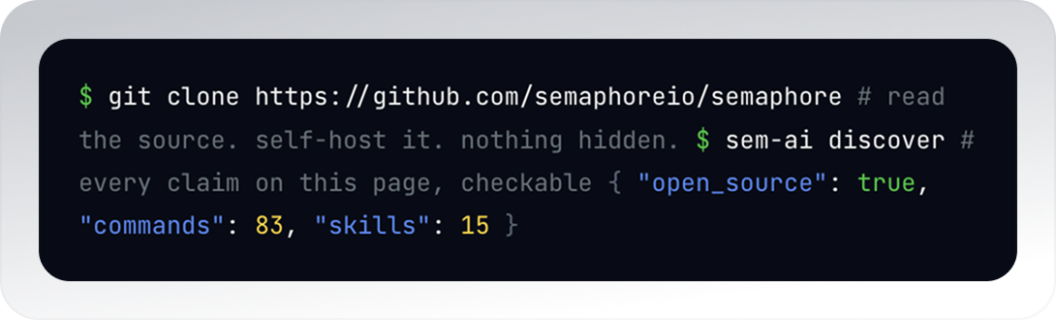
Semaphore is fully open source — read it, run it, self-host it, and check every claim on this page against the source. We fund the work by running the fast, scalable CI infrastructure we maintain, so you don’t have to — and you get back to shipping software that works.
These folks chose Semaphore

GoCo cut their continuous integration (CI) pipeline duration in half and reduced costs by 38% after migrating from CircleCI.
Semaphore has remained a great match for our needs as our workflows have grown in complexity.

“Semaphore is a great solution with an amazing support team that adapts to any need you have.“

We wanted one unified CI/CD system for the entire company—no more juggling tools across teams.

Semaphore reduced CI build times from over an hour to 10-12 minutes

Get started
Tell your agent what you want.
It runs your CI.
curl -fsSL https://raw.githubusercontent.com/semaphoreio/sem-ai/main/install.sh | sh/plugin marketplace add semaphoreio/sem-ai/plugin install sem-ai@semaphoreiocodex plugin marketplace add semaphoreio/sem-aicodex plugin add sem-ai@semaphoreioThen ask your agent to set things up — it connects to your org, and you start with $15 of free usage every month. No signup form.